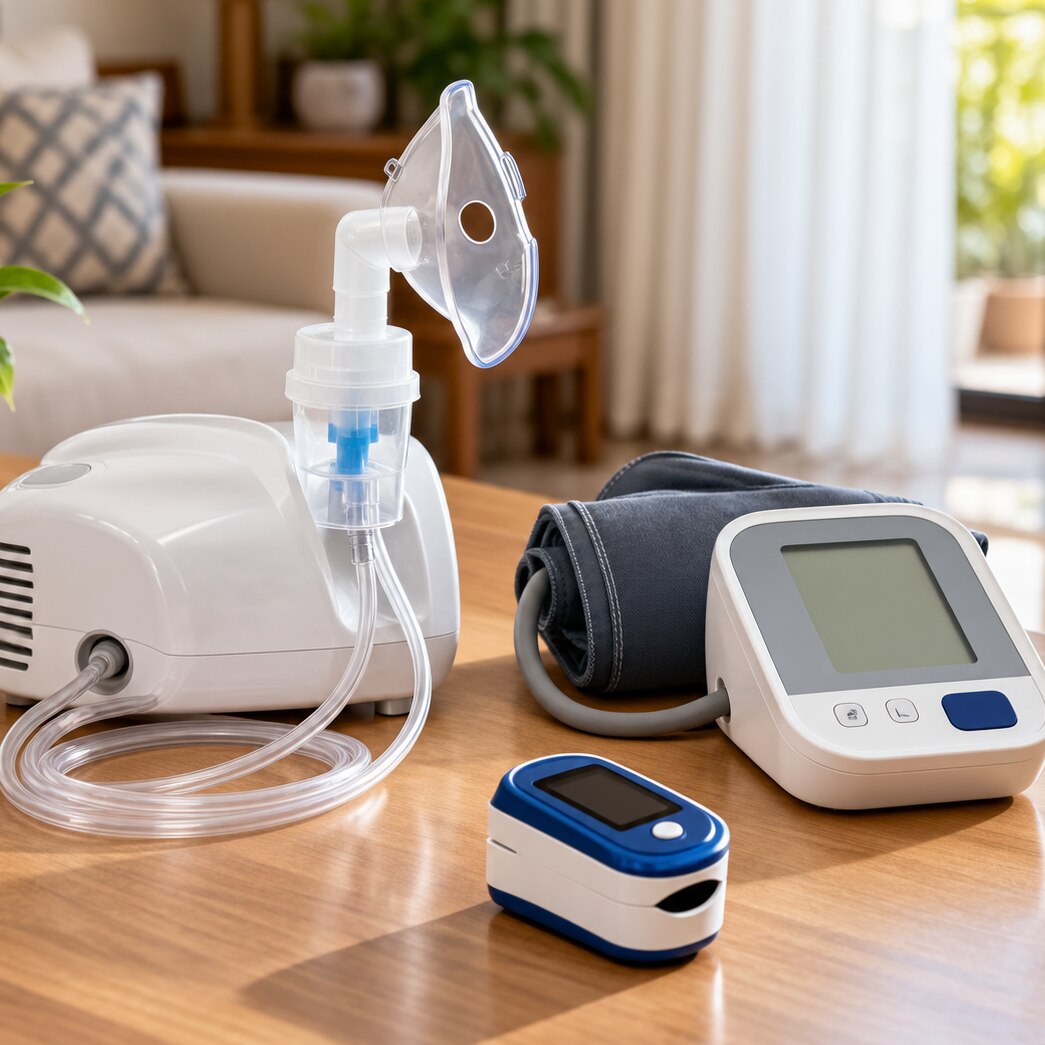
The wrong cuff, unsuitable nebulizer medication, or poorly positioned pulse oximeter can produce misleading results and wasted treatment time. By the end, you will be able to compare device types, check fit and validation, use each device correctly, and recognise when home readings need clinical or emergency attention.
Key takeaways
- Choose a validated upper-arm BP monitor with a correctly sized cuff.
- Position your arm at heart level and repeat readings using the same technique.
- Match nebulizer design to the prescribed medicine and the user’s abilities.
- Compare cleaning needs, treatment time, and replacement parts before buying.
Choose an upper-arm BP monitor before comparing features
The most dependable choice for home use is an automatic, validated BP monitor with a cuff that fits your upper arm. It gives more consistent results than a wrist blood-pressure monitor because the upper arm is easier to position at heart level.
| Option | Dependability trade-off | Best use |
|---|---|---|
| Automatic upper-arm BP monitor | Preferred for routine home readings when correctly fitted and positioned | Most people |
| Wrist blood-pressure monitor | Requires exact heart-level positioning; a small angle error can distort the result | When an upper-arm cuff cannot be used |
| Finger monitor | Produces less reliable readings and is not recommended for diagnosis or tracking | Avoid |
Check the exact model on an independent listing such as ValidateBP; “FDA-cleared” and “clinically validated” do not mean the same thing. Take the monitor to a clinic and compare it with the clinic’s equipment, because an app or stored readings cannot reveal a consistent device or technique error.
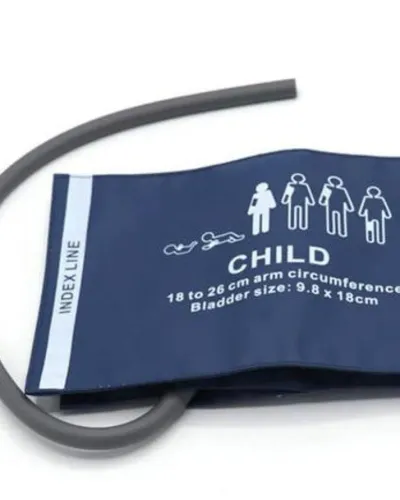
Measure your upper-arm circumference before buying. Match it to the manufacturer’s stated cuff size in centimetres, not simply to a small, medium, or large label; a cuff that is too tight or too loose can shift the reading.
For a repeatable reading:
- Avoid caffeine, exercise, and smoking for 30 minutes.
- Empty your bladder and sit quietly for at least 5 minutes.
- Support your back, keep both feet flat and uncrossed, and rest your arm at heart level.
- Take two readings at least one minute apart and record both.
Use a repeatable technique and know when readings need action
The reliable way to measure blood pressure at home is to repeat the same seated routine every time. Avoid caffeine, exercise, and smoking for 30 minutes, empty your bladder, then sit quietly for at least five minutes.
- Support your back, keep both feet flat and uncrossed, and rest your arm on a table at heart level.
- Place the correctly sized upper-arm cuff on bare skin, with its lower edge just above the elbow.
- Take two readings one minute apart. Record both numbers, the date, and the time rather than relying only on the monitor’s memory or app.
- Bring the monitor to a clinic appointment and compare it with the clinic’s device. This check is essential for home blood pressure accuracy because cuff fit, positioning, technique, or device error can create a consistent difference.
- If the monitor repeatedly displays an irregular-heartbeat alert, ask a clinician to confirm the reading; the alert is not a diagnosis.
One high reading does not establish hypertension. Share repeated home readings at or above 135/85 mmHg with a clinician, who can interpret them alongside your history and treatment.
A reading of 180/120 mmHg or higher requires action: sit quietly, repeat it after at least one minute, and contact a clinician urgently if it remains that high. Call emergency services immediately if that reading occurs with chest pain, breathlessness, weakness, confusion, or vision change.
Match the nebulizer design to the medicine and the user
The prescribed formulation, not the amount of visible mist, determines the right device. Confirm nebulizer medication compatibility by checking the medicine’s prescribing information against the model’s instructions for use; never substitute tap water, essential oils, household liquids, or an improvised solution.
| Option | How it works | Practical trade-off | Best fit |
|---|---|---|---|
| Compressor nebulizer | Compressed air breaks liquid into aerosol | Usually bulkier and noisier, with treatment time affected by the compressor and medicine volume | A user who needs a broadly compatible design and can tolerate noise or mains power |
| Ultrasonic nebulizer | High-frequency vibration creates aerosol | Can heat the liquid and may not suit suspensions or heat-sensitive medicines | A prescription specifically approved for that device type |
| Vibrating-mesh nebulizer | A vibrating mesh pushes liquid through tiny openings | Quiet and portable, but residue or clogging can reduce output | Children, frequent travellers, or users who need quiet treatment, if cleaning is reliable |
Before choosing, check these practical points:
- Ask whether the prescribed medicine is a solution, suspension, or viscous formulation. A suspension that works in one device may clog a mesh or fail to aerosolise properly in an ultrasonic nebulizer.
- Compare particle-size performance, residual volume, and stated treatment time for the exact medicine and dose. A visible mist does not prove that an effective amount reaches the lungs.
- Choose a mouthpiece or correctly sized mask that the user can hold securely. A child or person who tires easily needs a device that finishes treatment before fatigue causes poor breathing technique.
- Confirm the power source, noise level, replacement medication cups or filters, and whether the user can disassemble and dry the parts correctly.
Evaluate treatment time, cleaning, and replacement parts before buying
A manageable nebulizer fits the user’s daily routine, not just the medicine prescription. Nebulizer treatment time depends on the device, compressor, medication volume, formulation, aerosol output, and residual volume; a visible mist does not prove that an effective dose is reaching the lungs. A child or tiring adult may need a shorter, more efficient model.
Use this buying checklist:
- Time the prescribed dose with the intended user. Ask the seller for an approximate treatment time and confirm the device’s medication volume and residual volume.
- Check cleaning before purchase. The medication cup and mouthpiece or mask should come apart easily, follow the manufacturer’s cleaning instructions, and air-dry fully after each treatment. Do not wash tubing unless the instructions specifically allow it; trapped moisture can encourage contamination.
- Price the nebulizer replacement parts. Confirm availability and cost for nebulizer filters and medication cups, and ask whether the parts are standard or proprietary. A cheap machine becomes difficult to support when filters are unavailable.
- Confirm the user can hold the mouthpiece or tolerate the mask for the full session. Use only the prescribed inhalation formulation and dose—never tap water, essential oils, household liquids, or improvised mixtures.
When sourcing a home-care device through V. Karan Pharma, ask for the cleaning procedure, expected treatment time, and a reliable source for replacement parts before paying. If the user cannot clean, assemble, or sit through treatment safely, involve a caregiver or clinician.
Choose a pulse oximeter that you can use without overtrusting the number
A consumer pulse oximeter is useful only when you understand what its number can and cannot prove. Compare the labeled intended use, pulse oximeter accuracy information, stated testing conditions, and whether the device is authorized for the decisions you plan to make; a wellness score is not clinical monitoring.
Check that it measures oxygen saturation and pulse, shows battery status, has cleanable sensor surfaces, and uses readily available batteries.
| Model check | Prefer | Avoid |
|---|---|---|
| Intended use | Medical-purpose monitoring clearly stated on the label | A device marketed only for wellness when you need treatment guidance |
| Accuracy information | Stated accuracy range and conditions for use | Claims such as “hospital grade” without supporting details |
| Practical support | A readable display, secure finger clip, and available replacement parts | A cheap model with proprietary parts or difficult cleaning |
For a steadier reading, warm your hand, remove nail polish, sit still, and rest your hand below heart level. Pulse oximeter nail polish and cold fingers can distort the result; movement, poor circulation, tobacco residue, and darker skin pigmentation can also affect performance.
Wait for the number and pulse signal to settle rather than recording the first value.
- If the result seems low, repeat it on a warm, relaxed finger and check the sensor.
- Interpret oxygen saturation and symptoms together. Severe breathlessness, chest pain, confusion, or bluish lips needs urgent medical attention even with a normal display.
- Follow your clinician’s written oxygen target and flow plan; do not change oxygen solely because of one reading.
Frequently asked questions
Why choose an upper-arm BP monitor over a wrist monitor?
An automatic, validated upper-arm monitor is easier to position at heart level and gives more consistent results than a wrist monitor.
How can you make home blood-pressure readings more repeatable?
Use the same measurement technique each time, keep the cuff on your upper arm, and support your arm at heart level.
How do you choose a nebulizer for home use?
Match the nebulizer design to the prescribed medicine and the user’s ability to operate, clean, and maintain it.
What should you compare before buying a nebulizer?
Compare treatment time, cleaning requirements, and the availability of replacement parts.
How should you use a pulse oximeter reading?
Choose a pulse oximeter you can operate correctly, then interpret its number with the user’s symptoms and clinical advice rather than relying on the number alone.